
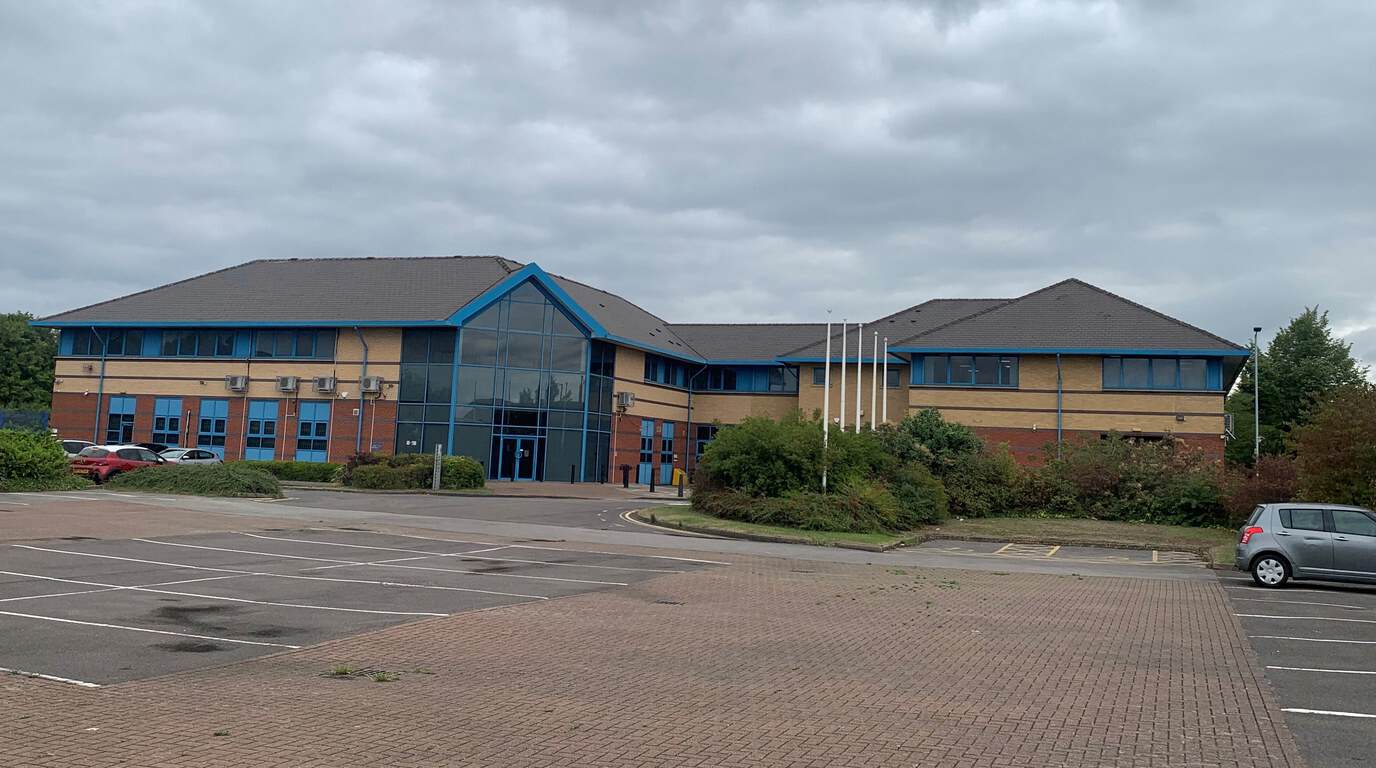
A change of use appeal has been allowed for Reresby House in Rotherham, granting planning permission to convert a largely empty office building into a place of worship and community hub for Hope Church.
The decision, issued by a Planning Inspector on 17 July 2026 under appeal reference 6005651, overturns Rotherham Metropolitan Borough Council’s refusal of the application in December 2025. It also allows part of the building to continue in temporary use as a ground floor workshop with associated first floor office, so that an existing business tenant can see out its lease.
Planning & Design Practice prepared the planning case and submitted the application on behalf of Hope Church.
A large office building the market had moved past
Reresby House sits within Bradmarsh Business Park, around 0.8km south of Rotherham town centre and close to Sheffield Road. It is a two-storey building of roughly 2,340 square metres, served by two car parks providing 74 spaces in total, of which 70 are standard bays and four are accessible.
The building had been in office use, but it had stood largely empty since December 2023 and had been marketed throughout that period. Only part of one wing remained occupied, by a business using ground floor workshop space with offices above, under a lease running to a break clause in 2028.
That vacancy mattered, because the site lies within an area allocated for industrial and business use in Rotherham’s adopted Sites and Policies document. Allocations of that kind exist to protect employment land, and they set a deliberately high bar for anything else.
Why the application was refused
Rotherham Metropolitan Borough Council refused the application, reference RB2025/1450, on 17 December 2025 for two reasons.
The first concerned the principle of the development. The Council considered that a place of worship would not be compatible with surrounding employment uses, would not positively contribute to the range and quality of employment opportunities in the borough, and would dilute the supply of employment land by taking a purpose built commercial unit out of use. That was found to conflict with Policy SP17, which governs alternative uses within business and industrial areas.
The second concerned parking. The Council took the view that the parking available would not be appropriate for the potential size of the congregation, and that the resulting overspill would harm pedestrian and road safety and the safe operation of the public highway.
Employment land policy, and why the wording mattered
Policy SP17 offers two routes to an alternative use in a business or industrial allocation. The first is to show that continuing the employment use would cause unacceptable planning problems that cannot be adequately mitigated. The Inspector found that route unavailable here, and it was not the one the case rested on. The second requires a proposal to be compatible with adjacent land uses, with any impact on amenity capable of mitigation, and then to meet one of two further tests: either the proposal positively contributes to the range and quality of employment opportunities in the borough, or the site is no longer required for employment use, or no longer viable for it.
The application did argue that the church would support jobs in administration, education, catering and event management at a building currently providing none. The Inspector was not persuaded that this amounted to a positive contribution in the sense the policy intends, so the case came down to the second of those tests, and to a point of interpretation that proved decisive. That test is framed in the alternative, separating the question of employment need from the question of viability with the word “or”. Satisfying either one is sufficient.
Marketing evidence prepared by Eddisons showed the building had been marketed for a period significantly exceeding the twelve months the policy requires, through both traditional and web based channels. The Inspector found no evidence that the marketing had been inadequate, that the lease terms were unreasonable or unattractive, that opportunities to secure an occupier had gone unexplored, or that any reasonable offer had been refused. A substantial rent reduction at the end of 2024 suggested, if anything, that the asking price had not exceeded market value.
On that evidence the Inspector concluded that continued employment use was no longer commercially viable and that the policy was satisfied. She went further, finding that even if the site were still needed to meet the borough’s economic development needs, the viability limb on its own would be enough, because the two requirements are alternative rather than cumulative.
Compatibility was addressed directly too. The Inspector accepted that a church, together with training courses, group meetings and conferences, is not consistent with the surrounding employment uses. She noted, however, that the policy asks for compatibility rather than consistency, and that no objective evidence had been put forward to show that the different function would cause unacceptable impacts on neighbouring businesses.
Parking, and the difference between assumed and evidenced harm
The parking reason for refusal turned on a similar question of evidence.
The Inspector accepted that the site would be heavily dependent on car travel, and accepted that 70 spaces would be insufficient for a Sunday congregation of 200 to 300 people, a point the church itself had acknowledged. Weekday activity was a different matter, with groups of up to 50 people and 46 spaces initially available, which she found adequate.
What mattered was where the Sunday overspill would go. Visiting the site on a Friday afternoon, which she was careful to describe as only a snapshot in time, the Inspector observed spare on-street capacity on Bow Bridge Close and Bradmarsh Way. Since the development’s peak demand falls on a Sunday, when surrounding business activity is likely to be significantly lower, she concluded that more capacity again would be available then, and that overspill could be accommodated within the business park.
Her wider point is a useful one for anyone facing a highways objection. Very little evidence had been provided to show that the proposal would cause actual harm to highway safety, and no compelling case had been made that drivers unable to park on site would park irresponsibly or dangerously. An assumed shortfall in spaces, in other words, is not the same thing as demonstrated harm. That distinction runs through national policy too. Paragraph 116 of the National Planning Policy Framework asks for an unacceptable impact on highway safety, or a severe residual cumulative impact on the road network, before development is refused on highways grounds.
A permanent base for a growing community offer
Behind the policy argument sits a straightforward practical problem. Hope Church, a family church affiliated to the British Assemblies of God, had been running Sunday services from a local school and weekday activities from a separate community venue, with recent Sunday attendance of between 180 and 190 people.
Its weekday programme includes a toddler group, a foodbank operating twice a week, a worship band and singing group, a monthly group for people aged 60 and over, and a youth group, each drawing up to 50 people. Letters of support submitted with the application came from the Trussell Trust and from the executive headteacher of a local primary school.
Bringing all of that under one roof was the purpose of the application. The approved plans use the existing floorspace rather than extending it, creating a main auditorium of around 180 square metres laid out for 184 seats, a further seating area shown with 157 places, an entrance lobby, a kitchen, offices and a series of flexible rooms for smaller groups across both floors. Cycle parking is also provided, with seven short stay stands and one secure locker.
The application also drew on the policy support that exists for facilities of this kind. Rotherham’s Core Strategy supports community and social facilities in accessible locations through Policy CS29, and the National Planning Policy Framework asks decision makers to plan positively for community facilities, places of worship among them. The site is on a key transport corridor, roughly 350 metres from bus stops on Sheffield Road.
How the planning case was made
Pre-application advice from the Council in March 2025 had flagged both of the issues that later became reasons for refusal, identifying Policy SP17 as the key hurdle and asking for input from a qualified highways consultant.
The application was built around that advice. Planning & Design Practice prepared the Planning Statement and the drawings, setting out the policy context, the planning history, the relevant precedent of an earlier change of use consent elsewhere in the same business park, and the assessment against each limb of Policy SP17. Marketing evidence was commissioned from Eddisons and a Transport Statement from SLR Consulting, so that the two contested issues were each answered with independent, specialist evidence rather than assertion.
The marketing evidence is what settled the employment land issue, and the Inspector’s findings on Policy SP17 follow it closely. Parking went differently. She did not accept that the spaces on site would be sufficient for a Sunday congregation, and decided that issue instead on where the overspill would go and on the absence of evidence that it would do any harm. On both issues, though, the reasoning turns on what had been demonstrated rather than what had been asserted. Assembling that kind of material early is central to how our planning consultancy team approaches difficult sites, and it is often what separates a refusal from a permission.
Permission was granted subject to two conditions: the standard three year time limit, and a condition requiring the development to be carried out in accordance with the approved plans.
What this change of use appeal shows about vacant employment buildings
Employment allocations do important work. They stop the steady erosion of the land a borough needs for jobs, and councils are right to apply them carefully.
But an allocation on a policies map is not the same as a realistic prospect of employment use. Here the Inspector noted that the only known interest in refurbishing the premises had been rejected as too costly and high risk, that any prospect of the site forming part of a future regeneration project was uncertain, and that high occupancy of smaller units elsewhere in the business park did not demonstrate demand for a building of this size. A property that had stood largely vacant since December 2023 pointed the other way.
For owners and occupiers sitting on empty commercial floorspace, the practical lesson is that these policies usually contain a viability route, and that the route is evidential. Thorough marketing over a sustained period, properly documented, with realistic pricing and terms, is what makes that argument available. It is worth knowing which tests a policy sets and which of them actually need to be met before an application is drafted, and worth remembering that a decision can be revisited through the appeal process. Further guidance on appealing a planning decision is available on GOV.UK.
How Planning and Design Practice can help
Planning and Design Practice is a multi disciplinary team of chartered town planners, architects, architectural assistants and heritage specialists. We advise on change of use, employment land policy and community projects, and we work with commercial clients, charities and public sector organisations from early strategy through to submission, decision and, where it is needed, appeal. Our architectural team prepares the drawings alongside the planning case, so that what is proposed and how it is justified are developed together.
For a free, no obligation consultation, contact Planning and Design Practice on 01332 347371 or enquiries@planningdesign.co.uk.