
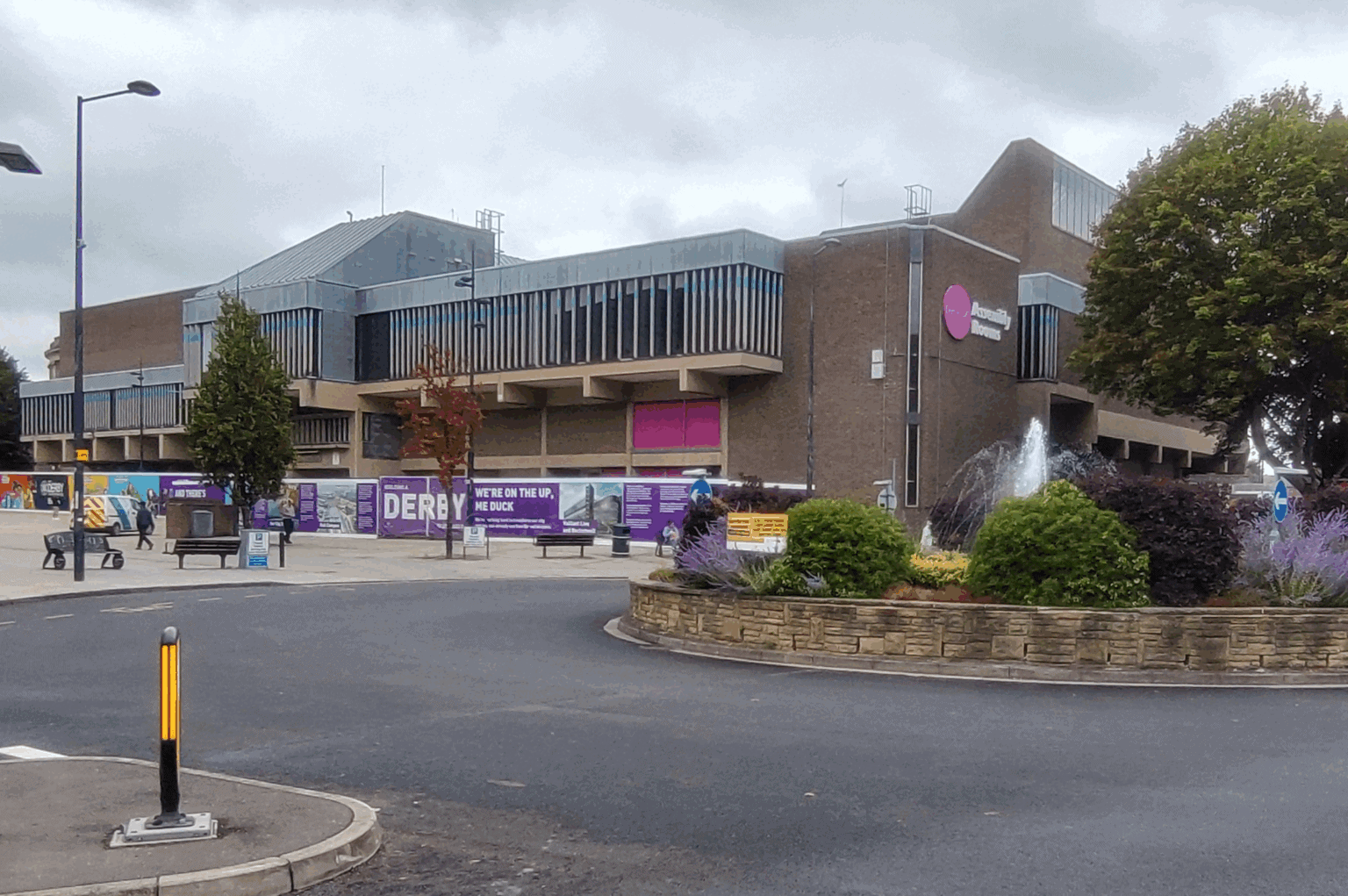
Planning & Design recently hosted George Scott, MPlan Student in Regional & Town Planning at the University of Liverpool as part of our work experience programme. We tasked George with looking at plans for the Assembly Rooms, something of a white elephant in Derby’s regeneration jigsaw, for his take on the potential of the site, an assignment to be reviewed by our Director,Chartered Town Planner and Heritage Specialist Jon Millhouse.
Derby Assembly Rooms – Assembling the options
A decade on from the 2014 fire (and five years after Derby City Council abandoned its ‘new Assembly Rooms’ project) the city’s most recognisable civic venue remains closed and lifeless in the heart of the Market Place. Just a brisk walk from the Cathedral in Derby’s historic centre, this once a thriving cultural hub now stands boarded-up and empty, its original function rendered obsolete with the new Valliant Live performance venue just a stone’s throw away. Yet the site is the key component of the council’s vision for a revitalised Cultural Quarter centered around the Market Place.
With the Derby MADE vision taking shape but still distant from delivery, the question resurfaces: should the Assembly Rooms be refurbished, demolished, or left in limbo? Public debate has waned in recent years, but the site remains emblematic of Derby’s civic and cultural identity. This article revisits the council’s past decisions, shifting cost estimates, and wider national policy trends to provide an evidence-based perspective on possible paths forward for this once-bustling venue.
Historical Role of the Assembly Rooms
The current Assembly Rooms, completed in 1977, were designed by the architectural firm Casson & Conder in a striking Brutalist style. This building replaced two earlier civic venues dating back to 1714 and 1763, maintaining a centuries-long tradition of gathering in Derby’s Market Place. While opinions on Brutalism remain divided, the structure’s presence in the historic city centre is undeniable despite the boarding below its great windows.
For decades, the Assembly Rooms served as a vibrant cultural hub, hosting concerts, exhibitions, civic ceremonies, and community events. Iconic performances by Elton John, Iron Maiden, and Take That, among others, drew residents and visitors alike. Its central Market Place location, a short walk from Derby Cathedral, reinforced the building’s symbolic and geographical significance, embedding it firmly at the heart of the city’s civic and cultural life.
Decline and Closure
The Assembly Rooms’ fortunes shifted dramatically following the 2014 fire in an adjacent plant room, which forced the venue’s closure. Despite the main structure remaining intact, years of inaction, rising maintenance costs, and safety concerns have left the building dormant and useless. Boarded-up entrances and underused spaces have muted its once strong presence, creating a conspicuous gap in Derby’s cultural and civic landscape.
Escalating costs and uncertainty around the building’s future compounded the problem. Initial feasibility studies suggested refurbishment could range between £18–24 million, depending on the scope, while estimates for a complete rebuild hovered above £50 million. These figures, alongside shifting political priorities, made it increasingly difficult for the council to commit to a clear course of action.

Abandoned “New Assembly Rooms” Project
Between 2018 and 2020, Derby City Council explored a “new Assembly Rooms” project, envisaging a modern, fully rebuilt cultural venue. However, the scheme was ultimately abandoned in January 2020, as forecast costs exceeded £30 million and questions over value for money mounted. The decision reflected both fiscal prudence and the complex challenge of delivering a high-profile cultural project within a historic urban centre, amid growing public scepticism of council- and government-led projects following widely publicised examples of mismanagement, such as HS2.
In the years that followed, debate over demolition versus refurbishment gained traction in the press and among local stakeholders. National and local heritage advocates, including the Twentieth Century Society, emphasised the building’s cultural and architectural significance, arguing that adaptive reuse could preserve civic identity while mitigating costs and carbon impacts.
Current Policy & Strategic Context – Derby MADE Vision
In January 2023, Derby secured £20 million in Levelling Up funding to support an ambitious redevelopment of the Assembly Rooms site into a purpose-built Learning Theatre. The proposal anticipated hosting an additional 25,000 visitors annually, generating an estimated £1.7 million per year in economic benefit. However, by November 2023, the Learning Theatre scheme was deemed unviable due to soaring inflation, interest rates, and borrowing costs. The funding was instead divided equally between refurbishing Guildhall Theatre and improving Derby Theatre—actions already aligned with other parts of Derby’s cultural fabric.
Despite this pivot, the Council continued to pursue regeneration of the Assembly Rooms site—naming VINCI Developments UK and ION Developments as strategic partners and launching public consultation for what’s now known as the Derby MADE scheme (a ~60,000 sq ft multi-use cultural building).

National and Regional Policy Trends
Levelling Up Fund Criteria
Levelling Up Fund criteria emphasise the cultural and economic revitalisation of underserved areas, benefiting smaller city centres. Derby’s initial funding success, and more recently its reallocation, underscore the volatility yet strategic importance of this funding stream.
Heritage Preservation and Adaptive Reuse Policies
The UK’s planning policy increasingly favours heritage preservation and adaptive reuse, reflecting climate-conscious agendas and the Retrofit-First movement (notably embodied in policies like the London Plan SI 2 and Circular Economy statements), which advocate retaining and upgrading existing buildings where feasible.
Derby’s cultural strategy prioritises sustainability, public realm activation, and historic identity, as seen in major investments such as the Museum of Making (£17m redevelopment), Market Hall, and Becketwell Performance Venue (Vaillant Live), all of which were structured to deliver year-round public engagement and align with broader regeneration frameworks.
George Scott, MPlan Student in Regional & Town Planning, University of Liverpool
Derby’s Assembly Rooms: Ten Years On – A review
The Assembly Rooms has always been a Marmite building; some people love it, many others hate it. The debate over whether to restore and reopen the venue or demolish and redevelop it was to a large extent settled when the City Council granted planning permission for its demolition in 2024. The council have insisted that demolition should only go ahead when a redevelopment scheme is agreed upon and fully funded. This is sensible -no one wants to see a giant hole appear in the historic heart of the city for an unknown length of time.
Concept plans produced on behalf of the council for the redevelopment of the site look great. If funding can be secured to turn this aspiration into a reality, all well and good. However if funding is not likely to be forthcoming, the council in my view need to be flexible in their approach. Another 10 years of the site laying dormant would not be acceptable. A generation of Derbians will have grown up knowing only a lifeless, boarded up hulk of a building framing the City’s primary public space.
The council’s proposals show a new 5-star hotel on the southeastern part of the site, where the tourist Information Centre used to stand. The hotel industry is relatively buoyant, and the recent opening of new performance and conference venue Vaillant Live offers further support. Securing private sector interest in this part of the scheme seems to me to be a realistic prospect. This part of the development could go ahead quickly.
The demolition of the western part of the complex which fronts the marketplace is likely to be more expensive however and will need public funding if it is to deliver a publicly accessible, civic use, which quite rightly is the council’s intention. To my mind, consideration should be given to retaining and repurposing this section of the building, at least for the medium term. This part of the building also happens to be more human in scale parts of the complex, better related to the marketplace and more readily convertible. It has a usable restaurant unit on the ground floor, with a colonnaded awning providing shelter for outdoor eating. There is the opportunity for a balcony terrace above. The facade is South facing, which would allow plenty of sunlight to permeate the building if additional window openings were added. Climbing plants could be installed to soften the building’s aesthetic.
The council’s proposal to replace the multi-storey car park with an office building is well-intentioned. Providing high quality office accommodation in the heart of the city would help with economic growth and footfall. However, I do wonder whether such an aspiration is economically viable. Demolition costs would be high and any replacement building would be constrained in height by the necessity to respect the setting of the nearby cathedral. With increasing trends for home working and co-working, recent office developments in the city have tended to favour the conversion of pre-existing buildings. Until such time as a viable redevelopment option for the multi-storey car park can be found, it could presumably be reopened for parking. There is always demand for city centre parking.
Overall, I admire the council’s ambition, and what has been achieved at nearby Becketwell should provide encouragement. It is imperative in my view that a solution is found quickly after 10 years of inaction. This may necessitate pragmatism and flexibility when it comes to the redevelopment options for the site.
Jon Millhouse, Director, Chartered Town Planner, Planning & Design Practice
Jon is both a Chartered Town Planner and a Full Member of the Institute of Historic Building Conservation, with a specialist interest in Historic Building Conservation.


Images prepared by Tina Humphreys and Joella Hinsley from our Architectural team showing the retention and repurposing of the western part of the Assembly Rooms.