
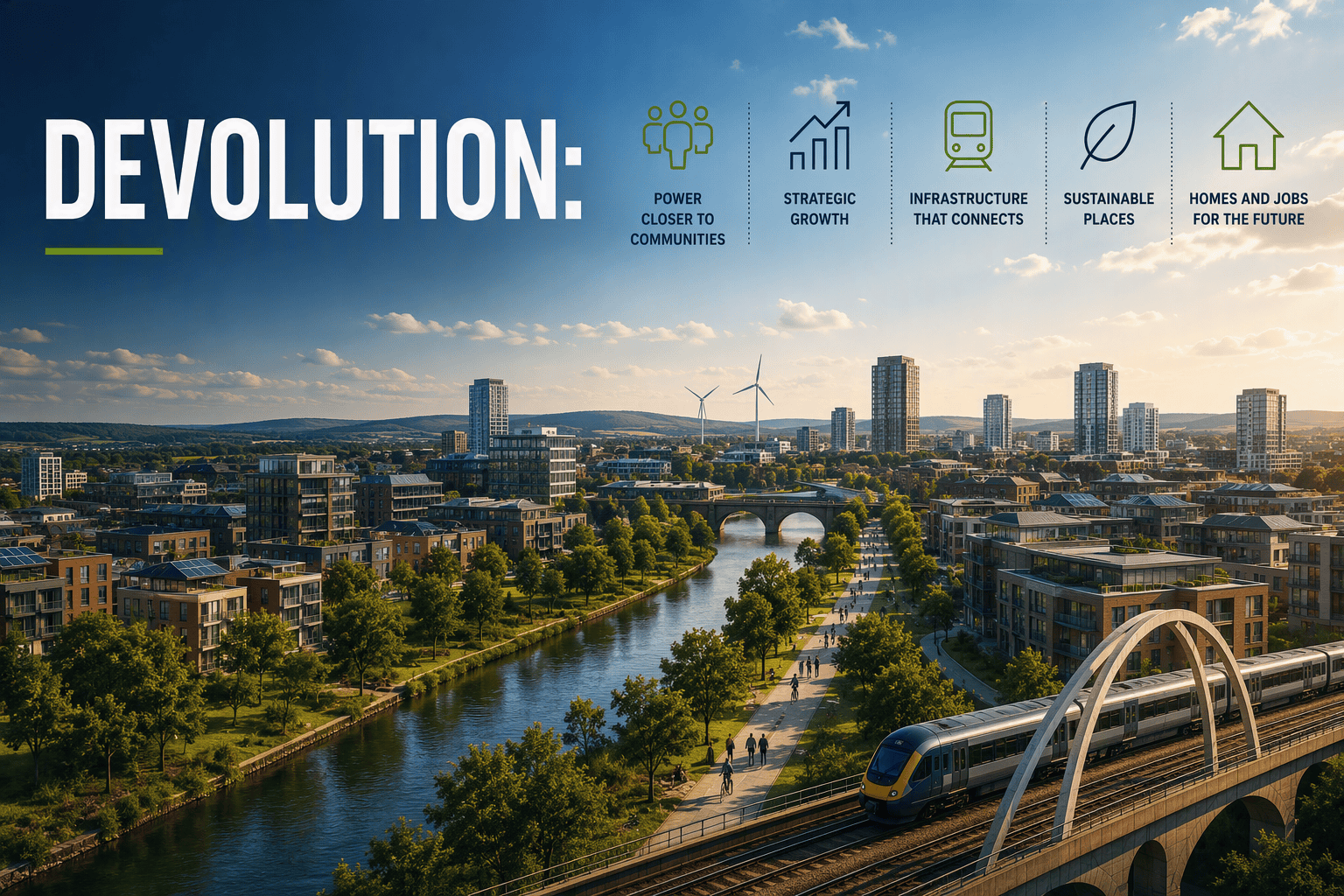
Over the past year, devolution has moved from being a policy discussion to becoming one of the most significant forces shaping the future of planning in England.
The Government’s commitment to transferring greater powers, funding and decision-making responsibilities to mayors and combined authorities has been described as the biggest shift away from Westminster in a generation. At the same time, proposed planning reforms are placing increased emphasis on strategic planning, infrastructure delivery and growth-led development.
In October we will see financial devolution roadmap presented and from spring 2027 greater share of business rates being retained by regional leaders to use in their patch. The monies can be ploughed into to assisting planning reform and speeding up the planning process which stalls many development sites.
For the sector, the question is no longer whether devolution is happening. The question is whether we are ready to make the most of it.
Why Devolution Matters
For decades, planning has often been caught between local aspirations and national priorities.
Local authorities have been tasked with delivering housing, economic growth, transport improvements and climate objectives, often without the powers or resources necessary to align those ambitions effectively.
Devolution presents an opportunity to bridge that gap.
By enabling decisions to be taken closer to the communities and economies they affect, strategic authorities have the potential to coordinate growth across administrative boundaries and align planning with infrastructure investment, skills, transport and economic development.
In simple terms, it creates the possibility for places to shape their own futures rather than having solutions imposed upon them.
The Return of Strategic Planning
Perhaps the most important implication for the profession is the renewed focus on strategic planning.
Many of the challenges we face today do not stop at local authority boundaries.
Housing markets are regional.
Transport networks are regional.
Economic growth corridors are regional.
Environmental systems are regional.
Yet too often our planning system has attempted to solve these challenges through fragmented decision-making.
The emerging devolution agenda offers an opportunity to think bigger. It encourages planners to consider how places function rather than where administrative boundaries are drawn.
For practitioners, that should be an exciting prospect.
Planning has always been at its best when it connects people, places, infrastructure and investment through a clear long-term vision.
A Challenge as Well as an Opportunity
Of course, devolution is not a quick fix. There is a risk that expectations will run ahead of capacity.
New governance structures, strategic authorities and regional responsibilities require skilled planners, planners who can navigate political complexity, engage diverse stakeholders and translate ambitious visions into deliverable outcomes.
The profession already faces well-documented resource pressures, particularly in local planning authorities. Without investment in planning capability and expertise, there is a danger that the benefits of devolution could be harder to realise than many hope.
Success will depend not just on new powers, but on building the institutional capacity to use those powers effectively.
What This Means for the East Midlands
For those of us working in the East Midlands, the implications are particularly significant.
The region sits at the heart of the UK, with major logistics, manufacturing, rail and development opportunities. Strategic investment decisions around transport, infrastructure and housing have the potential to unlock growth that no single authority could deliver alone.
Effective devolution could provide the framework needed to coordinate these opportunities at the scale they deserve.
The challenge will be ensuring that growth remains sustainable, inclusive and supported by the infrastructure communities need to thrive.
That is where planners have a critical role to play.
The Profession’s Moment
As planners, we often talk about creating places, shaping communities and planning for future generations.
Devolution offers the chance to do exactly that on a larger scale.
It encourages us to move beyond individual applications and site allocations and engage with the bigger questions:
- What should our regions look like in 20 years?
- How do we deliver growth alongside environmental stewardship?
- How do we connect homes, jobs and infrastructure more effectively?
- How do we ensure communities genuinely benefit from investment?
These are fundamentally planning questions and perhaps that is why this moment feels so important. The devolution agenda is not simply a governance reform. It is an opportunity for the planning profession to reassert its value as a strategic, place-shaping discipline at the heart of economic growth, infrastructure delivery and community wellbeing.
The profession should embrace that opportunity.