
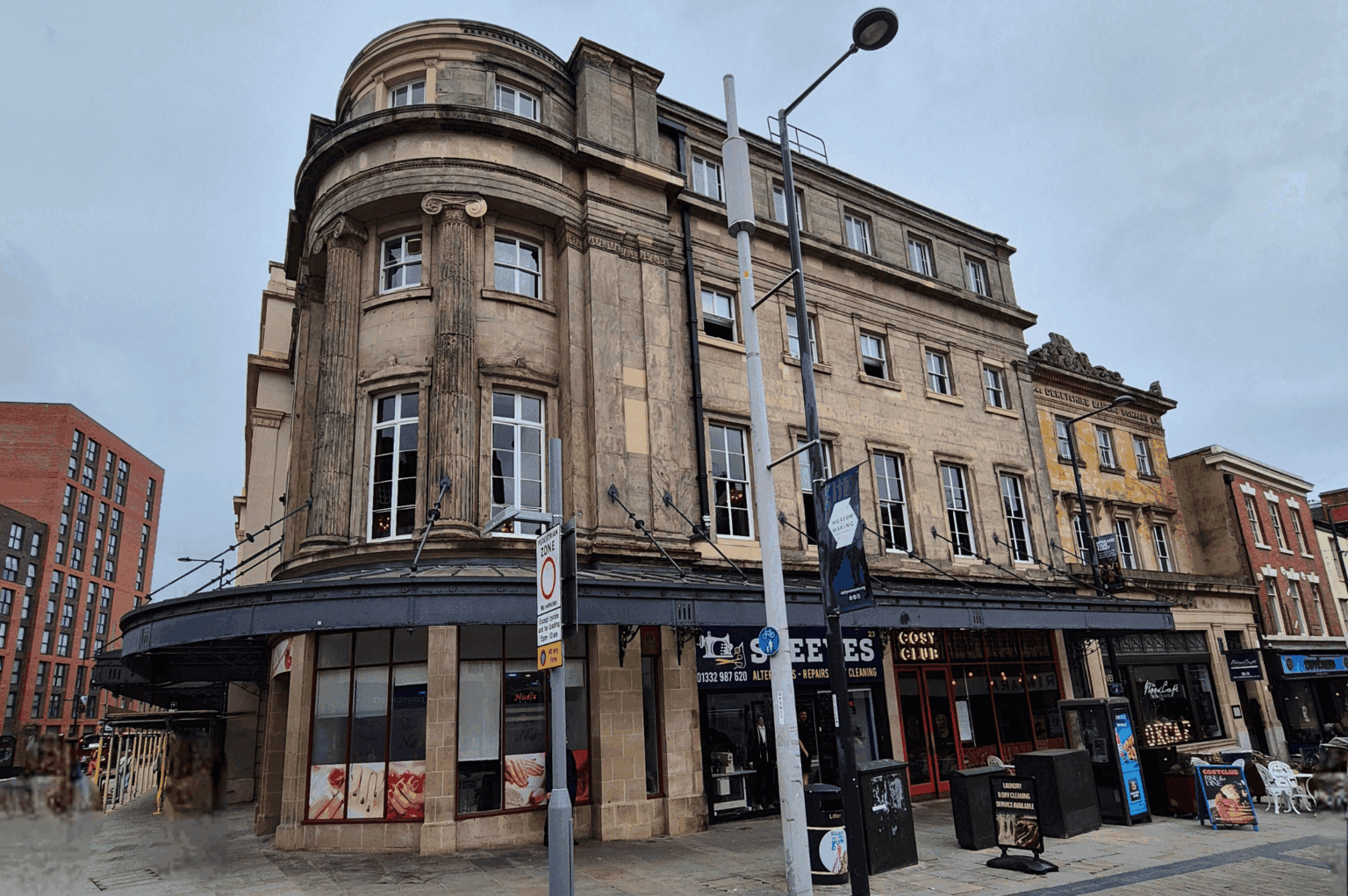
Planning & Design are pleased to announce that the final discharge of conditions have been granted for the Royal Exchange Buildings refurbishment in Derby.
The Royal Exchange Buildings, a Grade II Listed property located in a Conservation Area on Victoria Street in Derby’s city centre, has been a significant part of the city’s history. Clowes Developments led the way on a project to refurbish the existing offices on the third floor, which has led to the submission of a Listed Building application. This project aims to balance the need for modernisation with the preservation of a historic gem. This project has required the heritage significance of the Royal Exchange Buildings to be assessed and the impact its restoration may have. Clowes have now sold the buildings and we look forward to seeing what the new owners will do with this impressive property.
The Royal Exchange Buildings – a history
George Moneypenny’s map of Derby from 1791 provides a glimpse into the area before the Royal Exchange Buildings existed. The existing buildings along Brookside were cleared to make way for a new Post Office, hotel, and rooms for the Athenaeum society. The design, was selected from a competition, aimed to combine various public functions, and the resulting buildings were considered a substantial improvement to the town.
The Royal Exchange Buildings were divided into two parts – one with rounded corners featuring stone-faced Ionic demi-columns and the other with stucco finish, both showcasing elements of Greek architecture. The Athenaeum included a remarkable lecture room, ballroom, and newsroom. The building also housed the Derby Town and County Museum and Natural History Society in the 19th century.
In 1924, the Royal Hotel and Athenaeum underwent changes, including the conversion of the front into shop units. The building’s versatility is evident in its transformation into social service offices in 1951 and later into the Royal nightclub.
The Royal Exchange Buildings are part of a select group of around 390 statutorily listed buildings in Derby City, highlighting their architectural and historical importance. Historic England recognizes the archaeological and architectural significance of the building in the context of a wider nineteenth-century planned improvement.
The Derby Local Plan CP 20 outlines policies that require a thorough understanding of the heritage significance and potential impact of proposals on heritage assets. The Royal Exchange Buildings, being Grade II Listed, demand special consideration for preservation and enhancement.
The refurbishment seeks to respect the historic value of the building while allowing for necessary modifications. While there will be some minor impacts, such as the loss of elements from the 1950s refurbishment and additional partitions, these are considered of limited significance. The project aims to facilitate the active use of the top floor, benefiting the building’s long-term conservation.
In dealing with this application the City Council stated that it ‘has worked with the applicant / agent in a positive and proactive manner and has secured appropriate and proportionate improvements to the scheme which relate to the proposal and preservation of the historic fabric.’
Our Heritage Service
At Planning & Design we have an in-house team of consultants, conservation architects and architectural technicians who ensure that proposals are designed sympathetically to conserve and enhance historic buildings and sites.
We have worked on numerous schemes affecting Listed Buildings, Conservation Areas and the Derwent Valley Mills World Heritage Site. We have the expertise and specialist knowledge to achieve success with your project regardless of its size.
We always work with the client and local councils to get the best outcome. Please contact us on 01332 347371 or email enquiries@plannigdesign.co.uk if you require help with any assistance or advice with your own project or property.