
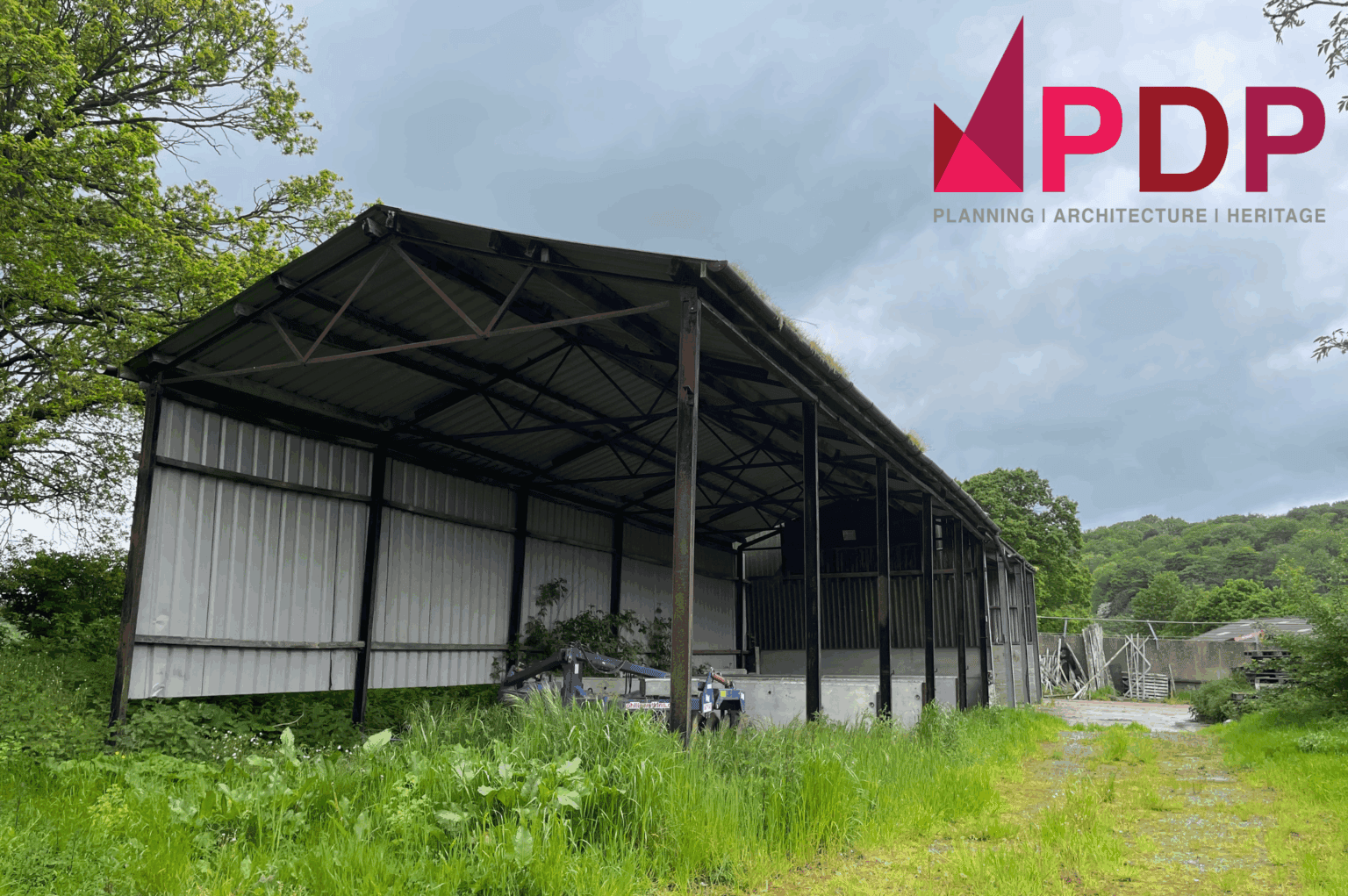
Planning & Design Practice Ltd are delighted to announce another successful Class Q fallback application, in partnership with Davey Stone Associates. This will allow our client to change the use of, and convert, unused agricultural buildings to form a new home not far from the village of Cawthorne, South Yorkshire.
Having secured Class Q approval last year, our Client was keen to build upon this success and submit a ‘fallback’ scheme.
The Permitted Development rights, commonly referred to as Class Q, is the right to convert agricultural buildings into homes as a matter of principle and has been with us since 2014.
Permitted Development (PD) is the right of an owner to develop their land within limits prescribed by a piece of legislation known as a General Permitted Development Order. The point of the order was originally to allow minor developments to go ahead without having to go through the planning application process, for example, small extensions to houses.
In the interest of simplifying the planning system and boosting the supply of houses, the previous government extended PD rights to include the right to change agricultural buildings to homes. Originally proposed as a temporary measure, this has since been made permanent.
A fallback scheme is a new application that proposes some additional works which are not constrained by Class Q limitations. Class Q is restricted to converting the existing building with minor additional measures required for the building to function as a dwelling. Once the principle of residential use is established via Class Q consent, works which would not usually be permitted via Class Q can be proposed.
The building in question consisted of two adjacent agricultural buildings within close proximity of each other. Barn 1 consisted of concrete blockwork and corrugated sheet metal cladding, with a steel portal frame. The barn was fully enclosed on three sides. Barn 2 was steel framed with profiled steel cladding panels, open on 2 sides. Crucially, the two barns were separate, with no structural features between the two.
Previously the two barns were designed to become one dwelling. Barn 1 was designed to contain the ‘main’ living spaces, including bedrooms, bathrooms, kitchen and living spaces. Barn 2 was designed to house the ‘ancillary’ features, including a gym, car port and workshop. The external alterations have been kept to a minimum to comply with Class Q legislation and to respect the rural aesthetic of the local area. This fallback application meant that a new glazed link could be proposed between the buildings, as well as solar panels and new external cladding. These works are possible as part of a fallback scheme, but not Class Q, resulting in a more energy efficient and aesthetically pleasing proposal.
Planning & Design Practice Ltd is a multi-disciplinary team of Chartered Town Planners, Architects, Architectural Assistants and Heritage Specialists.
Gaining planning permission is a key step in almost any development. We can take a project through from inception to completion, but we also offer the flexibility to engage a client’s own architects and provide a planning service, whilst our design team can also work with clients who have engaged other town planning professionals.
Planning & Design Practice Ltd are well versed in researching and understanding local Council’s policies to ensure the best possible case if put forward for our clients.
For a free, no obligation consultation to discuss your project, please don’t hesitate to get in touch on 01332 347371 or enquiries@planningdesign.co.uk


