
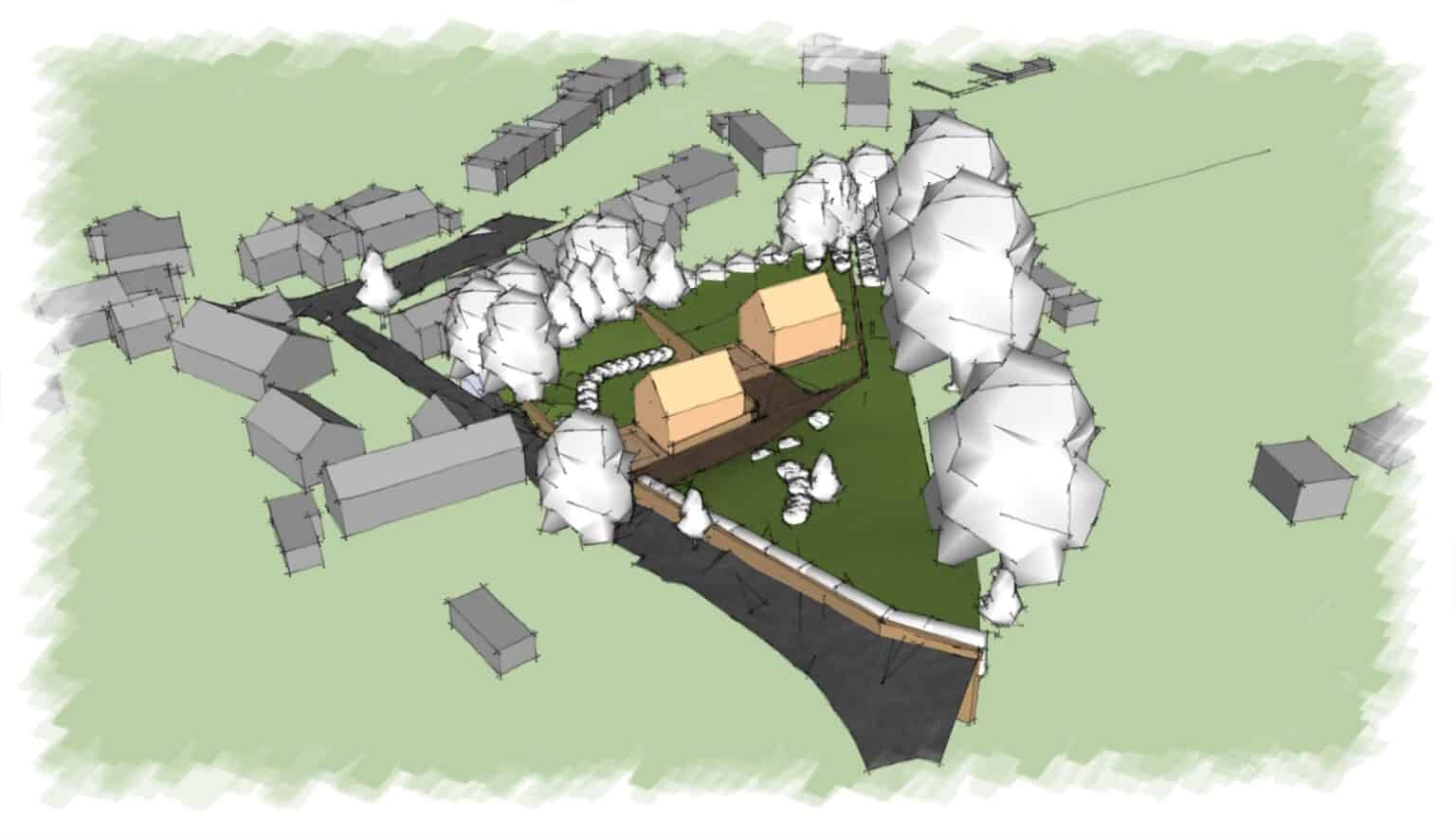
Infill development plays a significant role in shaping the sustainable growth of rural settlements, providing opportunities to make efficient use of land while preserving the wider countryside. The success of an infill proposal often hinges on how well it respects its context, both in terms of built form and the character of the surrounding settlement.
Settlement boundaries and built form definition
A key consideration is the settlement boundary or built‑form definition. Infill plots are typically better received when they sit comfortably within an existing cluster of buildings, contributing to a sense of “rounding off” or “completing” a frontage. Schemes that instead project into open fields or disrupt a clearly defined village edge are far less likely to be supported, as they risk eroding the transition between settlement and open countryside.


Scale and proportionality
Scale and proportionality are equally important. Rural settlements have evolved organically over time, often characterised by single-plot gaps or modest clusters of dwellings. Proposals that reflect this incremental pattern help maintain the hierarchy between villages, hamlets, and isolated rural buildings. Overly large or intensive schemes can appear out of place and conflict with the settlement’s historic form.
Character and vernacular coherence
Respecting character and vernacular coherence is essential. Successful infill development draws upon local materials, established plot patterns, traditional boundary treatments, and the orientation of nearby buildings. This does not preclude contemporary design, but it requires a thoughtful response that reinforces local distinctiveness.


Access and rural infrastructure
Developers must also demonstrate sensitivity to access and rural infrastructure. Rural roads, drainage systems, and community services often have limited capacity. Proposals should show that they can be accommodated without placing undue pressure on the environment or existing residents.
Avoiding coalescence
Finally, the avoidance of coalescence remains a central planning concern. Incremental infill that visually or physically merges separate settlements can dilute their individual identity and disrupt the rural landscape.
A careful approach to strengthen rural communities
When handled carefully, infill development can strengthen rural communities while preserving the character that defines them.