
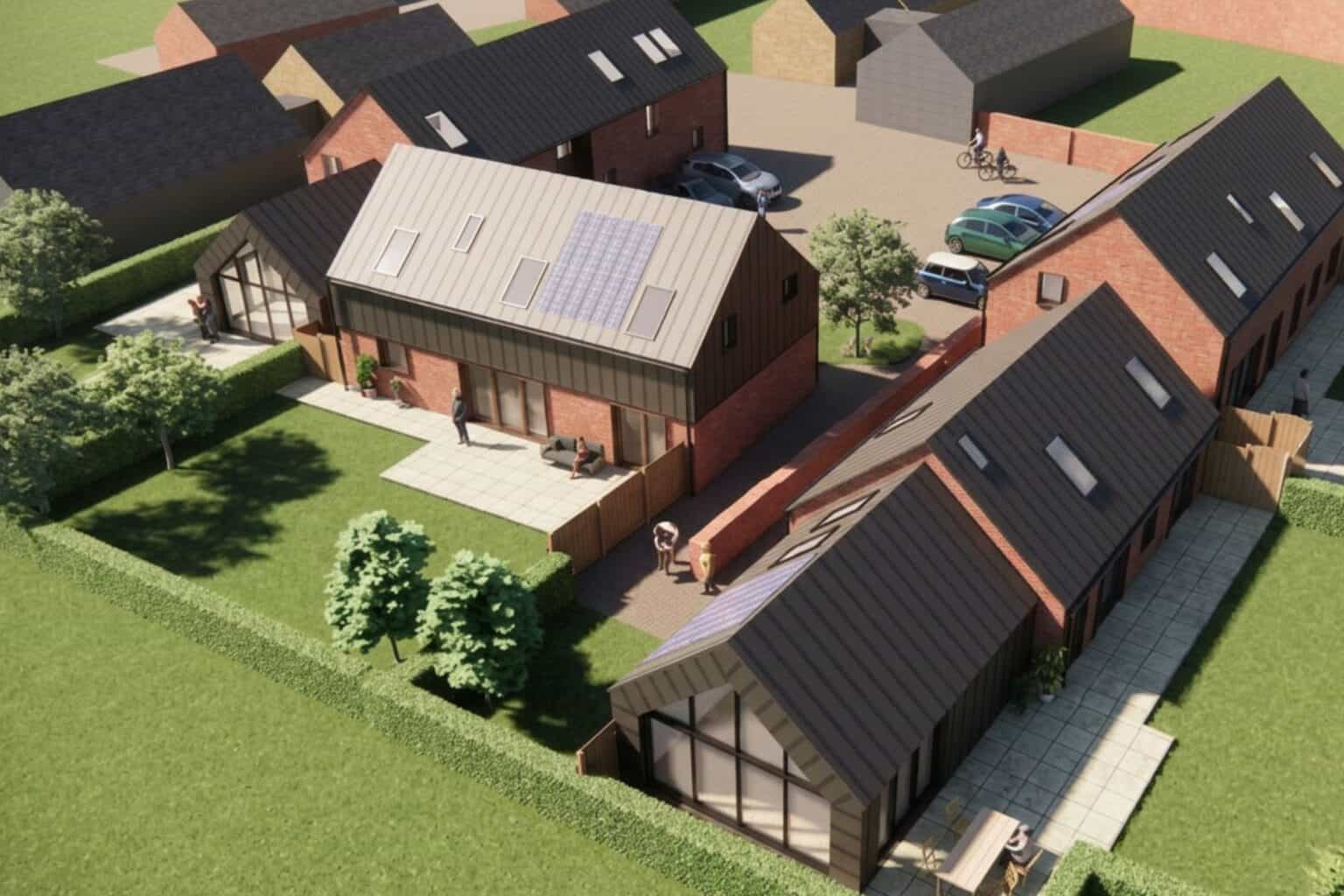
South Derbyshire District Council’s planning committee has unanimously approved plans for three new single-storey homes at a historic farmstead in Twyford, following the recommendation of the council’s planning officer. The decision brings a carefully revised, heritage-led scheme to a positive conclusion and marks another step in the sensitive renewal of a listed farmstead within the Twyford Conservation Area.
It is a good example of what a considered, heritage-first approach can achieve on a genuinely sensitive site.
A sensitive setting beside a listed hall
The farmstead sits within the Twyford Conservation Area, immediately north of a Grade II listed hall, and includes a group of traditional red brick barns that are themselves listed, arranged around a historic yard. Alongside them stood two tired modern steel-framed agricultural buildings. The wider site already had permission to bring the traditional barns back into use as homes, and this application dealt with the modern buildings at the eastern edge of the farmstead. You can see more about the scheme on our project page for this residential development in Twyford.
Responding to earlier concerns
An earlier proposal to replace the modern buildings with four new homes had not been supported, on the grounds that its design and layout would not sit comfortably alongside the listed buildings around it. Rather than press on unchanged, the scheme was revised from the ground up. The number of homes was reduced from four to three, the buildings were lowered from two storeys to single storey, parking was dispersed rather than gathered into a formal courtyard, and boundary walls and planting replaced fencing. A small outbuilding was added to keep everyday storage out of view. This is exactly the kind of careful, evidence-led work that our heritage planning specialists and architectural design services are there to do.
Turning a constraint into an enhancement
The result is a linear group of homes that echoes the rhythm of the traditional barns and reads quietly within the historic setting. The council’s conservation officer agreed that removing the poorer-quality modern buildings and replacing them with this lower, more restrained scheme would enhance the setting of the listed buildings and the Conservation Area, compared with the alternative that was already approved. That heritage benefit was central to the decision.
A finely balanced planning case
Because there is no policy that specifically supports replacing agricultural buildings with new homes in this rural location, the application conflicted with the development plan in principle. The case for approval rested on the planning balance: the strong heritage benefits, the reduction in the number of homes and the associated reduction in traffic and domestic clutter, together with secured ecological enhancements, were judged to outweigh that in-principle conflict. It is a reminder that a well-evidenced heritage and design case, prepared by an experienced planning consultancy team, can unlock a scheme that the policy position alone would not.
Part of a wider renewal
The approval sits within a carefully staged plan to bring the whole farmstead back into use. Alongside this application, we have been discharging planning conditions and helping to make a start on the approved conversion of the traditional listed barns into five homes, keeping that consent moving forward. Taken together, the work will give a redundant group of rural buildings a secure and sustainable long-term future, drawing on our rural development experience across the region.
How Planning & Design Practice can help
From heritage and design to the planning strategy that ties a scheme together, we help homeowners, landowners and developers bring sensitive sites forward with confidence. If you have a listed building, a farmstead or a site in a conservation area that you would like to make more of, please get in touch to speak to the Planning & Design Practice team.