
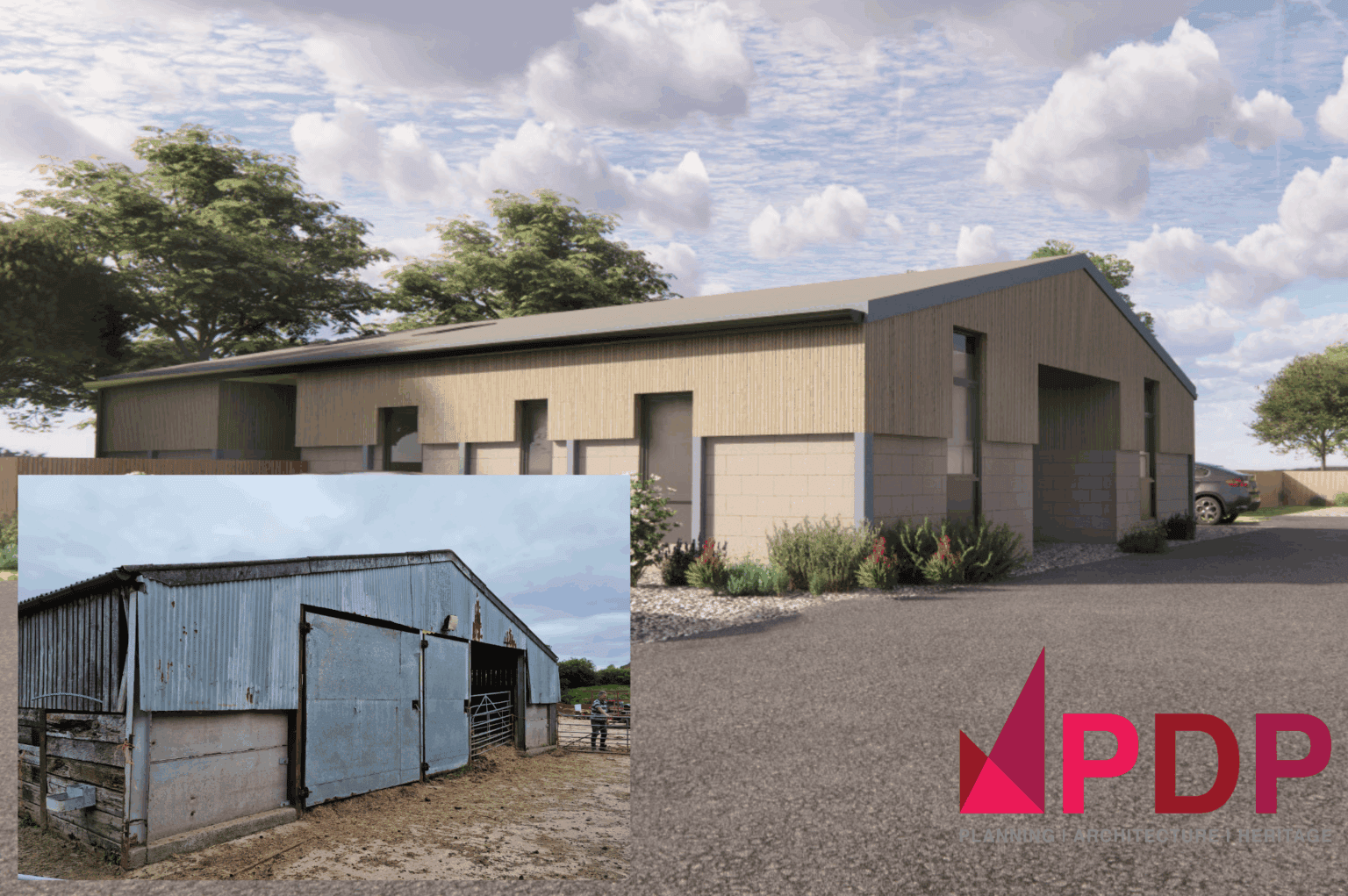
Farmers, rural landowners and owners of agricultural estates are increasingly looking for ways to diversify revenue streams. In light of constantly changing and challenging economic landscapes, rural diversification has become a key avenue to sustainable growth. Thankfully, there are several tools at your disposal when it comes to rural diversification, courtesy of the planning system.
Permitted development (PD) rights provide flexibility by allowing certain changes of use and building operations without full planning permission. However, it’s crucial to understand the limitations of these PD rights. The conversion of existing buildings, in particular through permitted development rights, is a popular option. The most popular two are known as Class Q and Class R, as well as Class MA.
Class Q – buildings on agricultural units and former agricultural buildings to dwellinghouses
Converting buildings on agricultural estates to residential use via permitted development rights is known as Class Q. These have undergone significant changes in recent years, most recently in May 2024. This now allows for up to 10 dwellings with a total of 1000sqm of residential floorspace, with each dwelling limited to a floorspace of 150sqm. This allows for flexibility in how the buildings can be divided and converted (e.g. ten 100sqm dwellings, eight 125sqm dwellings etc). Class Q also allows for minor works to facilitate the conversion, such as new windows, doors and exterior walls “reasonably necessary” to function as a dwelling. The other major change is allowing for the erection of rear extensions, up to 4 metres, on areas of existing hardstanding. The other notable changes can be summarised as:
- allowing the conversion of much newer buildings, with the ‘relevant date’ being reset to 24th July 2023;
- allowing protrusions to the external dimensions of the building of up to 0.2 metres to accommodate fixtures and fittings;
- allowing non-agricultural buildings to be converted (subject to certain criteria);
It’s important to remember that prior approval from local planning authorities remains necessary. Class Q is also still not allowed in protected landscapes, such as National Parks, Conservation Areas and National Landscapes (previously known as Areas of Outstanding Natural Beauty). Nor can they be applied to listed buildings or sites containing a scheduled monument. Class Q can be completed in the Green Belt, however. It is also important to note that developments that are granted permission by a development order (such as permitted development rights) are exempt from delivering a biodiversity net gain.
Converting these buildings to residential use opens the door for a number of opportunities on agricultural estates. The most common option is using selling these as open market dwellings. However, there is also the option to use these holiday lets or long-term rentals. This variety allows for further diversification of revenue.


Class R – agricultural buildings to a flexible commercial use
Class R allows for the conversion of agricultural buildings to flexible commercial use. These flexible uses include:
- General Industrial (Class B2)
- Storage & Distribution (Class B8)
- Hotels (Class C1)
- Outdoor sport & recreation (Class F2(c))
- Various Business Uses (Class E)
Class E is a broad category that encompasses many use classes, making it easier for farmers to convert buildings into businesses such as:
- Shops
- Post offices
- Restaurants & cafés
- Offices & professional services (e.g., estate agencies, solicitors, travel agencies)
- Gyms and indoor sports facilities
- Health clinics (including veterinary practices)
- Nurseries
- Light industrial spaces
It is important to note that a lot of these uses can be pursued whilst still running an active farm.
Similar to Class Q, Class R also allows up to 1000sqm to be converted. The building must have been solely in agricultural use on 3 July 2012 (or if then empty, when last in use before that date), or for at least 10 years before date of proposed change of use. However, Class R does not allow for building operations, such as new exterior walls or doors.
Class MA – commercial, business and service uses to dwellinghouses
Whilst Class MA does not specifically relate to agricultural buildings, there may still be opportunity to utilise it in certain scenarios. If farm buildings are currently being used as a farm shop or café, for example, Class MA could be an option. The key criteria here is that the building must be vacant for at least three months before applying for Prior Approval.
Full Planning Permission
Outside of permitted development rights planning policy in many local authorities allows for the conversion of existing agricultural buildings of substantial construction to be converted under full planning. Buildings that are of traditional construction, such as stone or brick built, often have Local Authority support. There is then the option to convert and re-use these buildings without the constraints attached to permitted development rights. This option doesn’t affect permitted development rights and has the potential to introduce even further dwellings to a farm. However, due to variations in local authorities planning policies, this is not always as straightforward as permitted development rights.
Finally, most farms include a farmhouse. Usually, the oldest and largest traditional building on site, many farmhouses are far bigger than a typically family requires. Additionally, these farmhouses will generally benefit from their own permitted development rights for rear and side extensions and loft conversions, which can further increase their size. In a lot of situations it can make sense to apply for full planning permission to split these large houses from one to two dwellings to better relate to the scale of the farmstead.


Agricultural estates: Conclusion
Exploring conversion opportunities at your farmstead or within your rural landholding can provide an exciting opportunity to diversify income streams. Navigating the various routes and legislation requires careful planning and guidance. Whether you want to convert your buildings into homes, offices or retail spaces, having a good understanding of the rules will help maximise your holdings potential.
The below table provides a summary of each option, provide a snapshot glance at what each option involves.
| Class Q | Class R | Class MA | Full Planning | |
| Convert to what use | Residential | Flexible Commercial | Residential | Any |
| Allows for Building Operations | Yes, but only those deemed reasonably necessary | No | No | Yes |
| Can it be done in a protected landscape? | No | No | No | Yes |
| Does it require a biodiversity net gain assessment? | No | No | No | Yes, most of the time |
| Require compliance with local planning policy? | No | No | No | Yes, most of the time |
Looking to diversify your agricultural estate? Obtaining planning permission for rural development can bring about significant gains and help to transform and maximise the value of your rural properties. However, development in the countryside is subject to strict planning controls which can make obtaining planning permission difficult.
Planning & Design Practice Ltd is a multi-disciplinary team of Chartered Town Planners, Architects, Architectural Assistants and Heritage Specialists with vast experience of working on projects for homeowners, landowners and farmers in rural areas with over 20 years of success in securing planning permission for rural development.
For more information or ask any questions relating to developing your agricultural estate please contact us on 01332 347371 or email enquiries@planningdesign.co.uk
Shaun Hyde, Charterd Town Planner, Planning & Design Practice Ltd
