
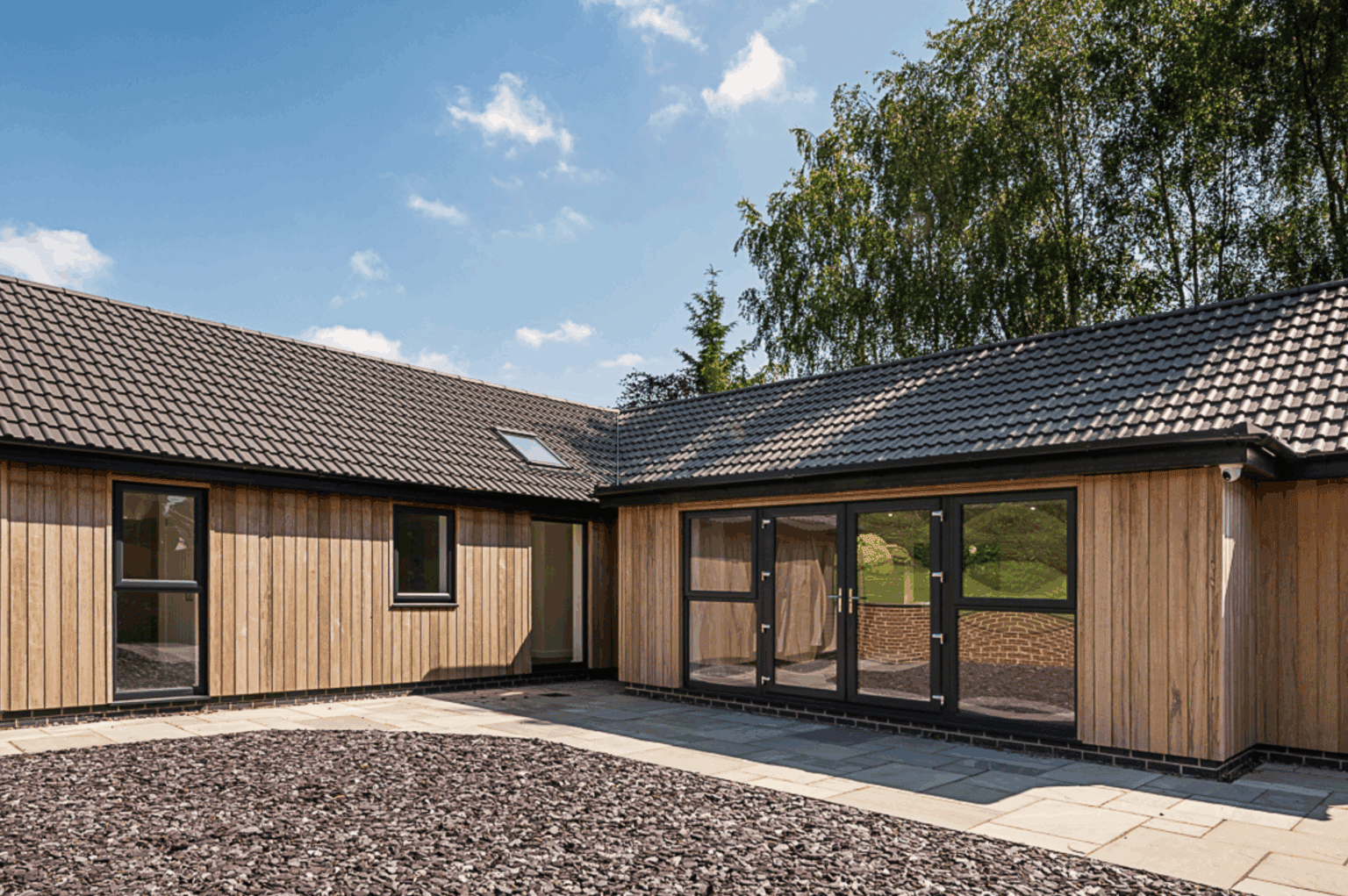
Over the last couple of months, we looked at how to find development opportunities in rural and village locations, and the importance of establishing high quality design principles when designing in context in order to create more sensitive proposals in rural settings.
This month we are shifting our focus to the delivery phase: Technical Design and Compliance. This is where the initial concepts are drawn up to the next level of detail in order to meet the necessary and critical building regulations.
Regulatory compliance is essential in design, but another factor to consider is sustainability. Sustainability is now a central element which influences design choices, development viability, and long-term value. In this article, we explore how these themes coincide, and why getting them right early can make all the difference.
The Technical Design Stage
So what is the technical design stage? Often referred to as RIBA Stage 4, the technical design stage takes the initial concept and planning drawings to the next level of detail so that they comply with the Building Regulations, in order to create a buildable, safe and viable design. The architectural team will work with third party consultants such as structural engineers, to produce detailed drawings and information ready for construction whilst also aligning with the Building Regulation requirements.
The technical design stage differs significantly from the earlier planning-focused stages. Whilst the planning stage is about securing planning approval and demonstrating the project’s feasibility, the technical design stage is about the detail and how the building will be constructed, serviced, and how it performs over time.
Here, the collaboration of architects, engineers, planning consultants and specialist consultants is essential in ensuring that the design not only aligns with the client’s vision, but also aligns with the building regulations, any planning conditions, and the scheme’s viability and longevity. The technical stage is a pre-construction phase where every detail and decision is assessed to prevent costly redesigns, delays or even failed approvals.
Building Regulations and Compliance
Every residential project must comply with Building Regulations, which set minimum standards for safety, sustainability, environmental performance, and accessibility. As discussed, architects and engineers fine-tune the design in order to ensure its safety and compliance.
A key focus in the technical design stage is sustainability and how we could integrate eco-friendly design methods, materials and principles into the design to minimise the project’s environmental impact. For example, your project could involve the use of renewable energy sources such as solar PV panels or ground source heat pumps, to name a couple. Incorporating energy efficient M&E (mechanical and electrical) solutions into a design can reduce its environmental footprint and future-proof the development.
Accessibility is another key aspect to consider in the technical stage. This ensures that the space is comfortable and inclusive for all its users. This might include features such as adaptable layouts and step-free access, ensuring that the design provides easy access and use for people of all abilities.
For residential developments in rural settings, there are some technical hurdles that are common to encounter. These may include:
- Ensuring the thermal performance of your building, using the right insulation and the structure’s airtightness is essential to establish comfort and longevity
- Looking at potential site access issues, particularly for emergency or waste collection vehicles.
- Establishing the site’s drainage and wastewater management, particularly in rural fields or areas that may not have current access to the mains drainage.
- Potentially needing to integrate biodiversity measures like bat boxes, hedgehog highways, or sustainable drainage systems (SuDS) if there is any habitat loss.
Many of these challenges can be mitigated or even turned into opportunities if addressed early. Early-stage consideration reduces cost and delays later on. Identifying and addressing these issues early in the technical stage is a proactive, ongoing process that plays a crucial role in keeping the project on track.

The Future Homes Standard and Beyond
Looking ahead, the regulatory bar is set to rise. The Future Homes Standard (FHS), coming into force in 2025, is the government’s response to climate change and the need for energy-efficient new homes. The FHS’ main goal is to greatly enhance the energy efficiency of new homes and reduce carbon emissions, aligning with the UK’s wider ambition to reach net zero by the year 2050.
Under The Future Homes Standard, from 2025, new homes built must produce 75-80% fewer carbon emissions than those built to the 2013 regulations. The FHS will also introduce similar targets for new non-domestic buildings.
The FHS states that new homes must also be ‘zero-carbon ready’ to adhere with the UK’s shift to a achieve a low-carbon future without requiring costly retrofits when shifting from the decarbonisation of the electricity grid and transition to electric heating. This means that fossil fuel heating systems will no longer permitted. Instead, heating will be delivered through low-carbon systems such as air source heat pumps.
Another key aim of the FHS, is to revolutionise new homes by focusing on highly efficient building envelopes through a ‘fabric first’ approach in order to improve insulation and minimise heat loss to create well-sealed buildings.
For developers, The Future Homes Standard demonstrates the importance of not just meeting the current regulations, but also anticipating for future ones. Projects that start today will be completed under tomorrow’s standards so it pays to design with resilience and future-proofing in mind.
Sustainability as a Driver of Value
Sustainable design is no longer just a “nice to have.” It’s increasingly becoming a core driver of development viability.
Today’s house buyers are becoming more informed and environmentally conscious. Therefore, there is an increase in buyer demand for more sustainable homes. This is mainly due to the lower running costs and better indoor air quality of the structure. Sustainable properties often have reduced energy bills, grants and funding which is linked to the building’s environmental performance. Thereby sustainable homes make the most economic sense.
Sustainable homes are also often more marketable as energy efficiency ratings (EPCs) now play a bigger role in insurance, valuation and money lending.
As a developer, embedding sustainability principles into your design from the outset can improve the long-term value and saleability of your projects, whilst also meeting the sustainability requirements and regulations.
Building Smarter, Building Greener
In today’s residential development landscape, the technical and sustainability considerations are now indivisible from successful rural residential developments. Sustainable and technical aspects are not just compliance hurdles, but strategic opportunities to deliver higher quality, more valuable homes which meet the evolving expectations and principles of future regulations.
At Planning & Design, we work closely with our clients to navigate the complex regulations required to ensure that your projects are not only compliant and safe but also future-ready.
So, if you’re at the early stages of a rural residential scheme, or considering one, now is the time to think ahead. Get in touch with us today to explore how we can help you to integrate sustainability and compliance into your design scheme from the outset.
Call 01332 347371 or email enquiries@planningdesign.co.uk to discuss your site today.
Beth White, Part II Architectural Assistant, Planning & Design Practice Ltd