
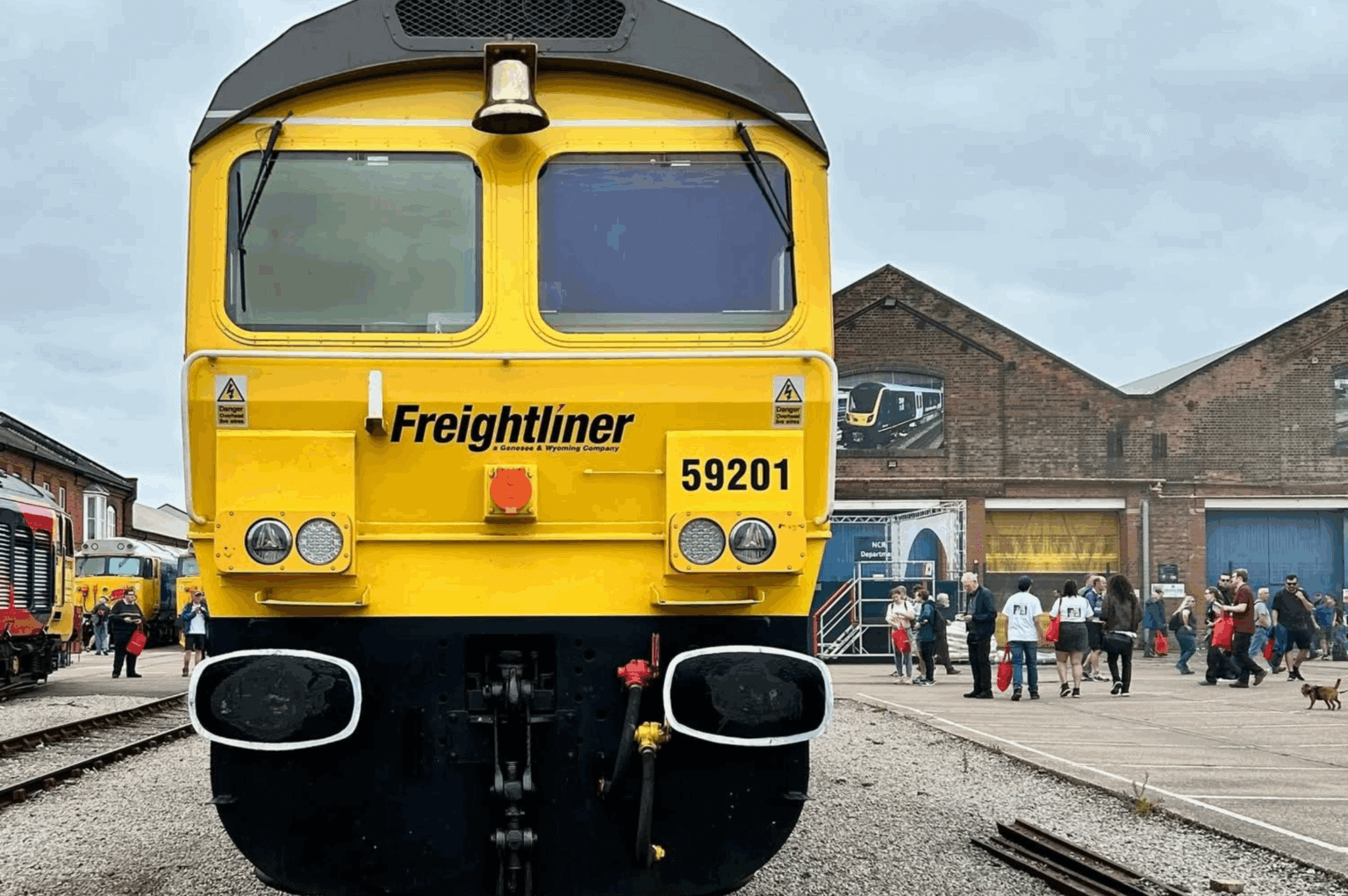
Inspired by a visit to the world’s largest railway festival, The Greatest Gathering that celebrated 200 years of the modern railway, our Heritage Consultant Ruth Matthews was full steam ahead looking at Derby’s rich railway heritage and the tracks it’s making for the future.
Train-maker Alstom has been reflecting on the success of The Greatest Gathering – the world’s largest railway festival – which it hosted at its Derby site at the beginning of August. Over three days, around 40,000 people from around the globe descended on the firm’s historic Litchurch Lane Works for the sell-out event, which celebrated 200 years of the modern railway. And I was one of them, I visited along with my Dad who has forensic knowledge of all things locomotive, we walked around the vast site and enjoyed the vision of rolling stock gathered from around the country preserved by some of the wonderful heritage railways we are lucky to have in this country. My favourite part was the vision of some of the most famous steam engines all lined up tooting and puffing steam! Also of interest to me was the model railways that depicted some of the local lost railway stations these bring to life our past in a very tangible way. The weekend prompted me to research Derby’s railway heritage a little more and it really is fascinating.
The Derby railway works’ history began in the 1840s, with the North Midland, Midland Counties, and Birmingham and Derby Junction Railways establishing workshops near Derby station. The North Midland’s facility became a full repair workshop and housed the world’s first railway roundhouse, built by Robert Stephenson in 1839 for the North Midland Railway, featuring a 16-sided design with a central turntable for efficiently to turn steam locomotives around. This design helped address the issue of early locomotives being optimized for forward travel. The roundhouse was part of a larger railway complex in Derby, which included buildings for carriage manufacture and office space.
Over time, the Midland Railway, formed in 1844, expanded its workshops, with notable leaders like Matthew Kirtley, who advocated for self-built engines. Kirtley solved coal-burning issues and improved production processes, including introducing steel and creating templates and gauges for standardization.

Annual dinner of the Institute of Mechanical Engineers, Derby, 1898. It was held in the carriage works of the Midland Railway Company. Photograph taken 1898, Public domain, via Wikimedia Commons
In 1873, Kirtley reorganized the works, and it was later split into Locomotive Works and Carriage and Wagon Works in 1873. The works continued to expand, and by 1900, it employed 40,000 people. During World War I, the factory contributed to war efforts, producing shells and components. The factory faced challenges with larger engines after the 1923 railway amalgamation into the LMS. Under successive leaders, the factory focused on locomotive development and research.
During WWII, the factory contributed to war production, including bombers and armaments. After nationalization in 1947, it continued producing locomotives, transitioning into diesel production in the 1950s. By 1966, it had built over 1,000 diesel locos. In the 1980s, British Rail Engineering Limited (BREL) became an independent entity, later privatized and acquired by ABB, then Bombardier.
After the closure of Derby Railway Works, the roundhouse narrowly escaped demolition and was later restored as part of Derby College’s main campus, preserving its historical and architectural significance. In 2021, Alstom, which acquired Bombardier, became a major player in UK rail manufacturing, continuing operations at the Litchurch Lane site.
The Great Northern Railway (GNR) was established in the 1840s, connecting London King’s Cross to York, and expanded its network through the East Midlands and Yorkshire by the 1870s. Its rivalry with the Midland Railway led to the GNR’s decision to build a new line through Derby, with the goal of breaking the Midland’s coal transport monopoly. This line, known as the Friargate Line, ran from Nottingham to Stafford, passing through key areas like Bennerley Viaduct, Ilkeston, Morley Tunnel, and Breadsall, before reaching Derby’s Friar Gate station.
The line continued westwards, crossing various streets and connecting to the Midland’s Derby-Crewe line. The route caused significant disruption, particularly in residential areas around Friar Gate and South Street, where several streets were demolished, including parts of South Street and Baxter Street. Uttoxeter Old Road had to be raised to accommodate the railway, causing steep junctions and the destruction of more Victorian housing. The route’s impact remains visible in modern aerial views of the city, even after the line’s closure.
The Great Northern Railway’s Friargate Station Bonded Warehouse, built in 1877-78 by Kirk & Randall, is an unusual design and includes a rectangular warehouse and a triangular office block with a mezzanine floor, spanning two to three storeys over a basement. The building was designed to face the proposed approach road from Friary Street to the station. The 11.5-acre Friar Gate Goods Yard site is now being developed by Wavensmere into over 110,000 sq ft of commercial space, alongside the construction of 276 new build homes.

Aerial View of Friar Gate. Showing the Bonded warehouse in the lower lefthand corner and the raised Uttoxeter Old Road towards the top left. In the central lower shows, the Friar Gate Bridge that cut through the existing Georgian Houses towards the station. Date flown: 22 April 1947
This brief overview of Derby’s railway heritage highlights the significant influence rail infrastructure has had on the city. It is only in recent years that Derby has begun making strides in revitalizing the large number of brownfield sites left behind following industrial decline. Derby College’s transformation of the Roundhouse has created an impressive venue that supports the aspirations of local students. Additionally, the Derbyshire Historic Building Trust‘s restoration of The Brunswick and the railway cottages across from Derby Train Station earned both a Housing Award and a Civic Trust Award. Meanwhile, Wavensmere’s purchase of the Friargate goods yard from Clowes marks the end of a long period of dereliction in that area and promises much-needed regeneration.
Other developments include East Midlands Railway’s first refurbished Class 158 train marking the next major milestone in its £60 million project to improve its regional fleet.
The train operator said the project will deliver a cleaner, more modern on-board experience and ensure the trains continue to provide a reliable and comfortable service for years to come. And the Rail Forum has announced it has relocated its headquarters to Derby’s ‘Station Quarter’ in advance of ambitious regeneration plans.
The national trade association, which represents almost 400 rail-related businesses, has moved to Paul Duval House, next door to Derby Midland Station and in the heart of Derby City Council’s ambitious plans to regenerate the area.
The Greatest Gathering | Gallery


Images from The Greatest Gathering, August 1- 3 2025. A three day festival that featured more than 140 iconic vehicles from the past, present and future of the railways, and the first time in almost 50 years that the historic factory was open to the public.